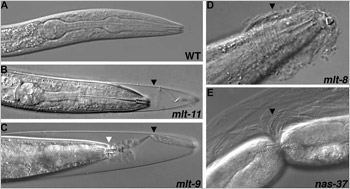
Patel, R., Galagali, H., Kim, J.K. and Frand, A.R. (2022) Feedback between a retinoid-related nuclear receptor and the let-7 microRNAs controls the pace and number of molting cycles in C. elegans. eLife, 11: 80010.
Article | PDF | PubMed
Katz, S., Barker, T., Maul-Newby, H., Sparacio, A., Nguyen, K., Maybrun, C., Belfi, A., Cohen, J., Hall, D., Sundaram, M., and Frand, A.R. (2022). A transient apical extracellular matrix relays cytoskeletal patterns to shape permanent acellular ridges on the surface of adult C. elegans. Plos Genetics, 18: e1010348.
Article | PDF | PubMed
Patel, R., and Frand, A.R. (2018) A Regulatory Loop between the Retinoid-Related Orphan Nuclear Receptor NHR-23 and let-7 Family microRNAs Modulates the C. elegans Molting Cycle. BioRxiv: 506261.
Article | PDF
Katz, S., Mayburn, C., Maul-Newby, H. and Frand, A.R. (2018) Non-canonical Apical Constriction Shapes Emergent Matrices in C. elegans. BioRxiv: 189951.
Article | PDF
Kelley, M., Yochem, J., Krieg, M., Calixto, A., Heiman, M.G., Kuzmanov, A., Meli, V., Chalfie, M., Goodman, M.B., Shaham, S., Frand, A.R. and Fay, D.S. (2015) FBN-1, a Fibrillin-Related Protein, Is Required for Resistance of the Epidermis to Mechanical Deformation During C. elegans Embryogenesis. eLife, 4:e06565.
Article | PDF |PubMed
Chin, R.M., Fu, X., Pai, M.Y., Vergnes, L., Hwang, H., Deng, G., Diep, S., Lomenick, B., Meli, V.S., Monsalve, G.C., Hu, E., Whelan, S.A., Wang, J.X., Jung, G., Solis, G.M., Fazlollahi, F., Kaweeteerawat, C., Quach, A., Nili, M., Krall, A.S., Godwin, H.A., Chang, H.R., Faull, K.F., Guo, F., Jiang, M., Trauger, S.A., Saghatelian, A., Braas, D., Christofk, H.R., Clarke, C.F., Teitell, M.A., Petrascheck, M., Reue, K., Jung, M.E., Frand, A.R., and Huang, J. (2014) The Metabolite α-Ketoglutarate Extends Lifespan by Inhibiting ATP Synthase and TOR. Nature, 510:397-401.
PubMed | Article
Monsalve, G.C., and Frand, A.R. (2012) Toward a Unified Model of Developmental Timing: A “Molting” Approach. Worm, 1:1-10.
PubMed | Article | PDF
Gomez, F., Monsalve, G.C., Tse, V., Saiki, R., Weng. E., Lee, L., Srinivasan, C., Frand, A.R., and Clarke, C.F. (2012) Delayed Accumulation of Intestinal Coliform Bacteria Enhances Life Span and Stress Resistance in Caenorhabditis elegans Fed Respiratory Feficient E. coli. BMC Microbiology, 12:300.
PubMed | Article | PDF
Moissiard, G., Cokus, S.J., Cary, J., Feng, S., Billi, A.C., Stroud, H., Husmann, D., Zhan, Y., Lajoie, B.R., McCord, R.P., Hale, C.J., Feng, W., Michaels, S.D., Frand, A.R., Pellegrini, M., Dekker, J., Kim, J.K., and Jacobsen, S. (2012) MORC Family ATPases Required for Heterochromatin Condensation and Gene Silencing. Science, 336:1448-65.
PubMed | Article | PDF
Monsalve, G.C., Van Buskirk, C., and Frand, A.R. (2011) LIN-42/PERIOD Controls Cyclical and Developmental Progression of C. elegans Molts. Current Biology, 21:2033-45.
PubMed | Article | PDF
Russel, S.E., Frand, A.R., and Ruvkun, G. (2011) Regulation of the C. elegans Molt by pqn-47. Developmental Biology, 21: 360: 297-309.
PubMed | Article | PDF
Meli, V.S., Osuna, B., Ruvkun, G. and Frand, A.R. (2010) MLT-10 Defines a Family of DUF644 and Proline-rich Repeat Proteins Involved in the Molting Cycle of Caenorhabditis elegans. Molecular Biology of the Cell, 15:1648-61.
PubMed | Article | PDF
Hayes, G.D., Frand, A.R., and Ruvkun, G. (2006) The mir-84 and let-7 Paralogous MicroRNA Genes of Caenorhabditis elegans Direct the Cessation of Molting via the Conserved Nuclear Hormone Receptors NHR-23 and NHR-25. Development, 133:4631-41.
PubMed | Article | PDF
Frand, A.R., Russel, S., and Ruvkun, G. (2005) Functional Genomic Analysis of C. elegans Molting. PLoS Biology, 3:1720-1733.
PubMed | Article | PDF
Frand, A.R., and Kaiser, C.A. (2000) Two Pairs of Conserved Cysteines are Required for the Oxidative Activity of Ero1p in Protein Disulfide Bond Formation in the Endoplasmic Reticulum. Molecular Biology of the Cell, 11:2833-2843.
PubMed | Article | PDF
Frand, A.R., Cuozzo, J. W., and Kaiser, C.A. (2000) Pathways for Protein Disulphide Bond Formation. Trends in Cell Biology, 10:203-210.
PubMed | Article | PDF
Frand, A.R., and Kaiser, C.A. (1999) Ero1p Oxidizes Protein Disulfide Isomerase in a Pathway for Disulfide Bond Formation in the Endoplasmic Reticulum. Molecular Cell, 4:469-477.
PubMed | Article | PDF
Chen, E.J., Frand, A.R., Chitouras, E, and Kaiser, C. A. (1998) A Link Between Secretion and Pre-mRNA Processing Defects in Saccharomyces cerevisiae and the Identification of a Novel Splicing Gene, RSE1. Molecular and Cellular Biology, 18:7139-7146.
PubMed | Article | PDF
Frand, A.R., and Kaiser, C.A. (1998) The ERO1 Gene of Yeast is Required for Oxidation of Protein Dithiols in the Endoplasmic Reticulum. Molecular Cell, 1:161-170.
PubMed | Article | PDF